You open Polymarket for the first time and see “67%” next to a political event. Is that good? Is that too high? What does it even mean? Prediction market odds are actually one of the most intuitive forms of probability once you understand the logic behind them. This guide breaks down exactly how to read and interpret prediction market odds — whether you’re comparing platforms on Prediction Terminal or placing your first trade.
What Prediction Market Odds Actually Represent
Unlike traditional sports betting, prediction market odds are expressed as percentages rather than fractional or decimal formats. A 67% probability means the market collectively believes there is a 67 in 100 chance that a specific outcome will occur.
This number is not set by the platform. It is determined organically by trader activity — buyers pushing the price up when they believe an outcome is more likely, and sellers pushing it down when they disagree. This crowd-driven pricing is what makes prediction markets uniquely valuable as information aggregators.
For example, if a market shows “Trump wins 2028 presidential election: 47%,” that reflects the consensus of thousands of traders putting real money behind their beliefs.
YES vs NO: Understanding Both Sides
Every prediction market outcome has two sides: YES and NO. Their prices always sum to approximately 100% — the small gap represents the platform’s fee or spread.
For example, if YES is trading at 47%, then NO is trading at approximately 53%. Buying NO is equivalent to betting against the outcome. This is important because sometimes the most interesting opportunity isn’t the YES position — it’s the NO.
When comparing platforms on Prediction Terminal, you’ll notice that the YES/NO split can differ between Polymarket and Kalshi for the same event. This discrepancy is meaningful and represents a potential trading opportunity for those who have a view on who is right.
Implied Probability vs True Probability
Market odds give you implied probability — what the market believes. Your job as a trader is to assess whether the true probability is higher or lower.
If you believe there is a 70% chance of an event occurring, but the market prices it at 50%, you have identified an edge. This gap between implied and true probability is where profits come from in prediction markets.
Building this assessment requires research, data, and context. Historical base rates, polling data, expert opinion, and breaking news all feed into your view of the true probability. Prediction Terminal’s odds comparison helps you quickly identify where different platforms disagree — which is often a signal worth investigating.
Reading Odds Movement Over Time
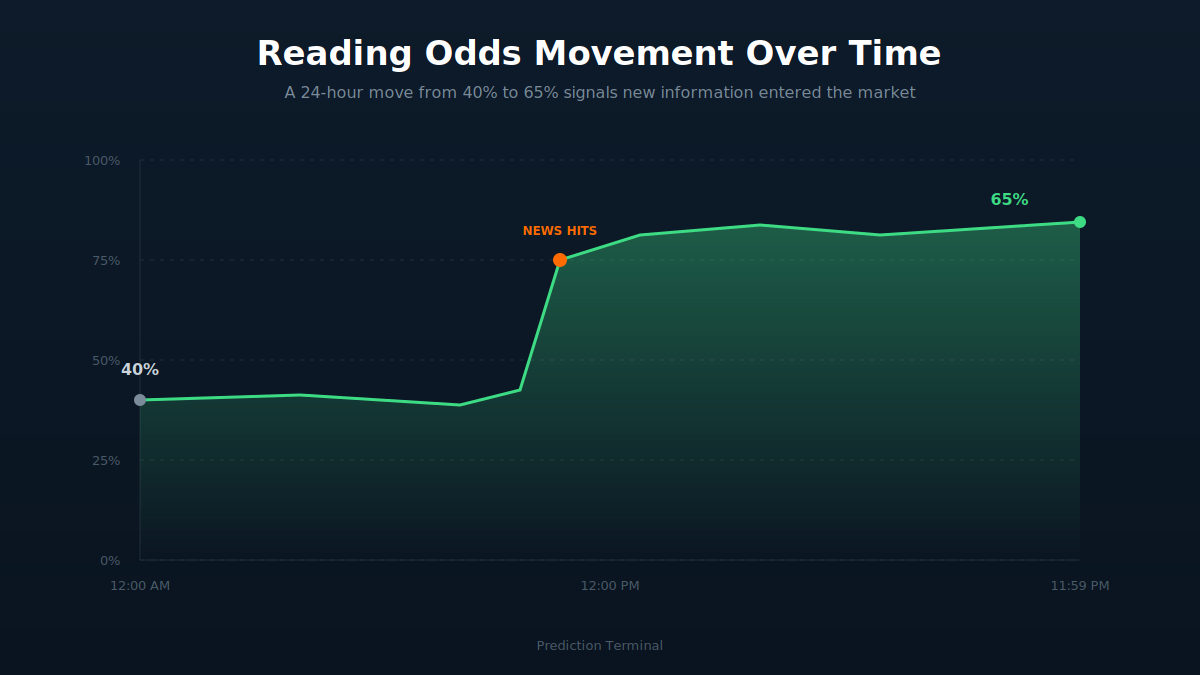
Odds at a single point in time tell you less than odds movement over time. On Prediction Terminal, the chart view shows you how a market’s probability has shifted over 1D, 1W, 1M, and ALL timeframes.
A market moving from 40% to 65% in 24 hours is telling you something significant happened — new information entered the market. Sometimes this is news you’re already aware of. Sometimes it’s a signal that smart money knows something you don’t.
Watch for sudden moves in otherwise stable markets. Those spikes and drops are often the most information-rich signals prediction markets produce.
Start Simple, Then Go Deeper
If you’re new to prediction markets, start by reading odds as simple probabilities. A 70% outcome is more likely than not. A 20% outcome is unlikely but possible. Build your intuition on markets you know well — sports events you follow, economic releases you track, or political races in your region.
As your confidence grows, layer in liquidity analysis, platform comparison, and odds movement. Prediction Terminal is built to support all of these layers in one dashboard — from simple odds reading to cross-platform discrepancy hunting.
Explore live markets on Prediction Terminal and start developing your read of the market.
Frequently Asked Questions
What does a 67% probability mean in a prediction market?
It means traders collectively believe there is a 67 in 100 chance the outcome will occur. This price is set organically by buying and selling activity, not by the platform.
What is the difference between YES and NO prices?
YES and NO prices always sum to approximately 100%, minus a small spread for platform fees. Buying NO is equivalent to betting against the outcome that YES represents.
What is implied probability vs true probability?
Implied probability is what the market currently prices in. True probability is your own assessment based on research and data. A gap between the two is what creates a trading edge.